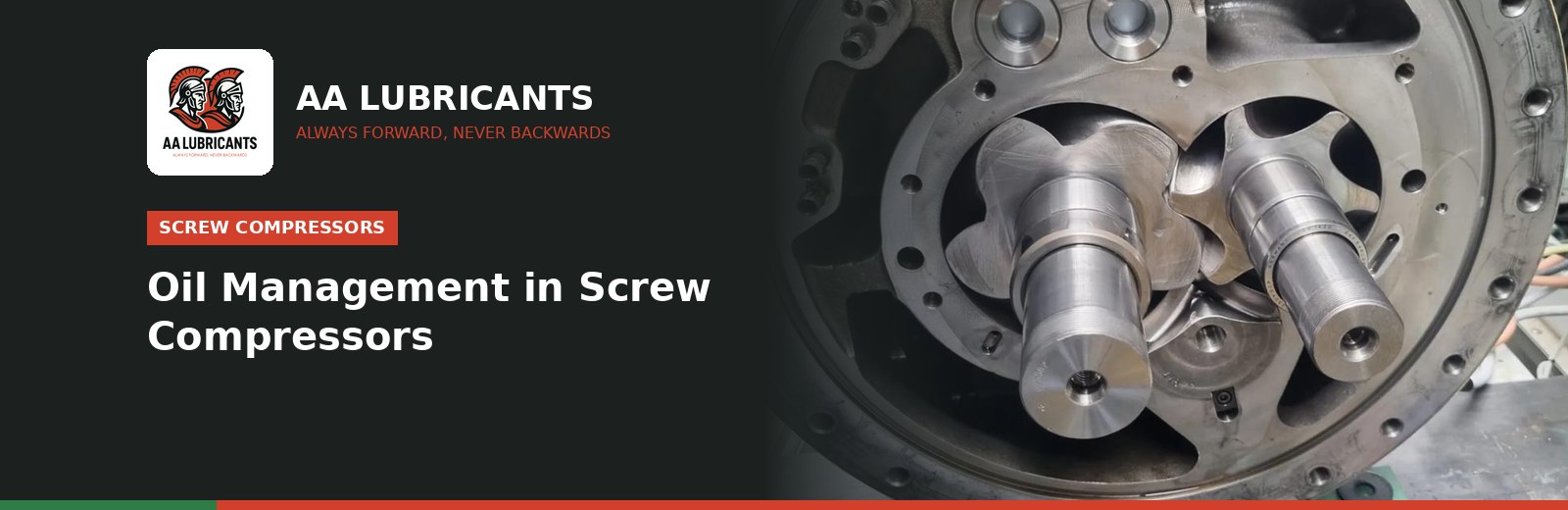
Oil does three jobs inside a screw
A twin-screw refrigeration compressor compresses gas in the pockets between a male and a female rotor. The rotors never touch each other or the housing, which is why screw compressors are durable, but the clearances between them are paths for gas to leak back from high to low pressure. Oil is injected into the compression chamber in large quantities to do three things at once:
- Seal the rotor-to-rotor and rotor-to-housing clearances, directly determining volumetric and isentropic efficiency.
- Cool the gas during compression, absorbing a large share of the heat of compression and keeping discharge temperatures within limits.
- Lubricate the rolling-element bearings that locate the rotors and carry the axial thrust generated by the pressure difference.
Because oil flow is so much higher than in a reciprocating compressor, the oil circuit around a screw is a system in its own right, and the lubricant's properties affect every part of it.
The oil circuit, step by step
| Component | Function | What the oil must do |
|---|---|---|
| Oil injection and bearing feed | Delivers oil to the rotors and bearings, usually driven by the pressure difference | Flow freely at the injection temperature while providing enough working viscosity at the bearings |
| Oil separator (primary and coalescing stages) | Removes oil from the discharge gas so it is not carried into the system | Release entrained gas quickly and resist foaming; drain efficiently from coalescing elements |
| Oil cooler (water, thermosyphon or liquid injection) | Removes heat absorbed during compression | Remain thermally and oxidatively stable at discharge temperatures |
| Oil filter | Protects bearings and close-tolerance parts | Stay clean: low deposit formation, no sludge or varnish |
Because the separator sits on the high-pressure side, the oil there is saturated with refrigerant at discharge pressure. This is why screw compressors typically use high-viscosity grades such as ISO VG 170 or 220 in POE, or ISO VG 68 to 150 in alkylbenzene for HCFC duty. The extra base viscosity offsets the heavy dilution in the separator.
Common oil-related problems in screw plant
High oil carry-over
Symptoms: falling separator level, frequent top-ups, reduced evaporator performance. Causes include failed or saturated coalescing elements, a separator operating outside its design velocity, foaming oil, or an oil that is too light for the separator design. Carry-over is also the primary route by which oil logs in evaporators.
Foaming
Foaming occurs when dissolved refrigerant flashes out of the oil faster than bubbles can escape, typically at start-up or after rapid suction pressure drops. Good defoaming characteristics are part of the specification of our RF POE and RF AB screw grades, but persistent foaming usually points to oil temperatures too close to saturation, or contamination.
High discharge or oil temperature
Poor oil cooling accelerates oxidation, raises acid number and thins the oil at the bearings. Check cooler fouling, liquid-injection control and oil flow before blaming the oil.
Bearing distress
Screw compressor bearings run with fine clearances. Low working viscosity, particle contamination and water all shorten bearing life. Bearing failure in a screw is expensive: rotor contact can follow within hours.
Oil analysis as condition monitoring
A large screw compressor holds a significant oil charge and circulates it rapidly through every critical component. Regular oil sampling is therefore one of the cheapest and most informative condition-monitoring tools available to a plant engineer.
| Test | Indicates | Typical action |
|---|---|---|
| Viscosity @ 40°C | Contamination with a different oil, dilution, degradation | Investigate a sustained change of more than about 10% from the new-oil value |
| Acid number (TAN) | Oxidation or hydrolysis | Trend over time; a rising trend calls for investigation of moisture and temperature |
| Water (Karl Fischer) | Moisture ingress | Check driers, low-side leaks, and handling of top-up oil |
| Wear metals (Fe, Cu, Al, Sn, Pb) | Bearing and component wear | Compare with previous samples; a step change warrants inspection |
| Particle count | Filter performance, ingress | Change filters, find the source |
The value of oil analysis lies in the trend. Take samples from the same point, at the same operating condition, at regular intervals, and keep the history. Our technical team can help you set up a sampling point, interval and alarm levels suited to your compressor.
Choosing a screw compressor oil
- HFC and HFO chillers and industrial plant: RF POE 170 or RF POE 220, according to the compressor OEM's viscosity requirement and the separator dilution.
- R-22 screw compressors: RF AB 68 for medium machines, RF AB 100 for large machines and high-load duty, RF AB 150 for very large heavy-duty screws.
- Retrofits and conversions: see our article on R-22 phase-out retrofits before changing refrigerant or oil type.
Running a screw compressor and not sure your oil is doing all three jobs? Send us the compressor model, refrigerant, discharge and oil temperatures, and any recent oil analysis to sales@aalubricants.co.za.


