Why miscibility decides whether oil comes back
Every compressor carries some oil into the discharge line. In a well-designed system that oil is dissolved in liquid refrigerant in the condenser and liquid line, and carried by refrigerant velocity through the evaporator and suction line back to the crankcase. If the oil and refrigerant are not mutually soluble, the oil separates out as a separate phase, most often in the evaporator, where temperatures and velocities are lowest. There it coats tubes, reduces heat transfer, and stays. The compressor slowly loses its charge until the bearings run starved.
Miscibility is therefore the first question in oil selection. Viscosity, additives and price come after it.
The five oil chemistries in refrigeration
| Base oil | AA Lubricants range | Polarity | Good miscibility with | Key limitation |
|---|---|---|---|---|
| Naphthenic mineral oil (MO) | RF MO 32 to 100 | Non-polar | CFCs, HCFCs (R-22), hydrocarbons | Effectively immiscible with HFCs and HFOs |
| Alkylbenzene (AB) | RF AB 68, 100, 150 | Non-polar, better solvency than mineral oil | R-22 and HCFC service blends (R-401A, R-402A, R-408A, R-409A) | Not suitable for HFC or HFO |
| Polyolester (POE) | RF POE 32, 55, 68, 170, 220; RF POE 85 CO2 | Polar | HFCs (R-134a, R-404A, R-407C, R-410A, R-507), many HFOs, R-22, subcritical CO2 | Hygroscopic: absorbs moisture and can hydrolyse to acids |
| Polyalkylene glycol (PAG) | RF PAG 46 | Highly polar | R-134a in mobile air conditioning | Very hygroscopic; not for stationary systems unless OEM-specified |
| Polyalphaolefin (PAO) | RF PAO 68 | Non-polar | Mobile A/C aftermarket service where the circuit is designed around low solubility | Relies on system design for oil return rather than solubility |
The pattern is simple: polar refrigerants need polar oils. Chlorine-containing HCFCs like R-22 dissolve comfortably in mineral and alkylbenzene oils. Chlorine-free HFCs and HFOs need ester or glycol chemistry.
Reading a miscibility table
Our technical data sheets quote a low-temperature two-phase separation temperature for each refrigerant at several oil concentrations. It is the temperature below which a given oil and refrigerant mixture splits into two liquid layers. For reliable oil return, the separation temperature should sit comfortably below the lowest evaporating temperature the system will see.
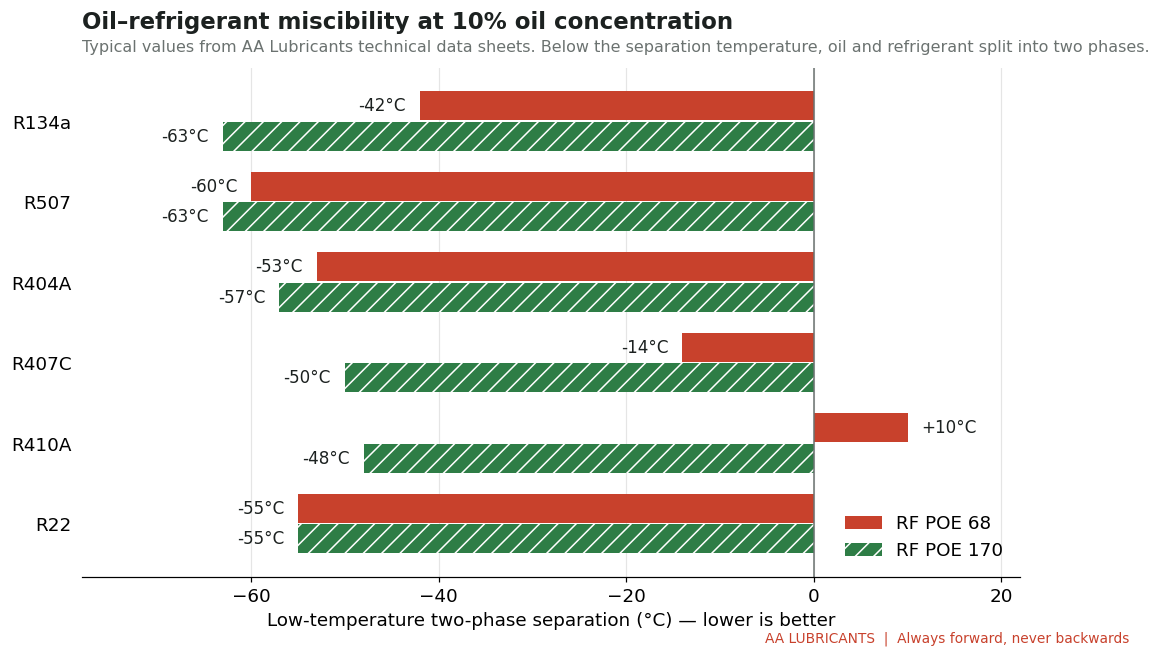
The table below compares two of our POE grades at 10% oil concentration, using typical values from our data sheets:
| Refrigerant | RF POE 68 (10% oil) | RF POE 170 (10% oil) |
|---|---|---|
| R-134a | -42°C | -63°C |
| R-507 | -60°C | -63°C |
| R-404A | -53°C | -57°C |
| R-407C | -14°C | -50°C |
| R-410A | +10°C | -48°C |
| R-22 | -55°C | -55°C |
Two engineering lessons stand out:
- The same chemistry does not mean the same miscibility. Ester structure matters. RF POE 68 is fully miscible with R-134a, R-507 and R-404A well below typical low-temperature evaporating conditions, but with R-410A it shows a separation point near +10°C at 10% oil. It should not be the default choice for an R-410A system unless the compressor OEM approves it.
- Refrigerant blends behave differently from their components. R-407C and R-410A contain R-32 and R-125, which are less soluble in some esters than R-134a. Always check the data for the actual refrigerant, never an assumed "HFC" category.
Where oil return fails in practice
- Low-temperature evaporators (freezer rooms, blast freezers) where the oil is coldest and most viscous.
- Oversized suction risers with too little gas velocity to lift oil, especially at part load on capacity-controlled compressors.
- Retrofitted systems where residual mineral oil from an R-22 past sits in an HFC circuit. The residual oil is immiscible and accumulates.
- Parallel racks where oil equalisation between compressors depends on consistent return to each crankcase.
The right oil chemistry does not fix poor pipe design, but the wrong chemistry will defeat the best pipe design.
How we select
When AA Lubricants recommends an oil, we check the refrigerant, the lowest evaporating temperature, the expected oil circulation rate and the OEM approval list, and compare them against the separation data for each candidate grade. That is the difference between supplying oil and engineering a lubrication solution.
Unsure whether your current oil is right for your refrigerant? Send the compressor model, refrigerant and operating temperatures to sales@aalubricants.co.za and our technical team will check it for you.


