The installed base is still large
Under the Montreal Protocol, developing countries including South Africa are phasing down HCFC consumption on a schedule that reaches a 97.5% reduction by 2030, with only a small servicing allowance thereafter. New R-22 equipment has largely disappeared from the market, and R-22 supply is tightening and becoming more expensive. Yet a large installed base of R-22 chillers, cold rooms, process coolers and air-conditioning plant is still in service across South Africa, Zimbabwe, the DRC and the wider region.
Owners face three options: keep the plant running on R-22 as long as possible, retrofit to an alternative refrigerant, or replace. Lubrication is central to all three.
Option 1: Keep R-22 plant healthy
For plant that will stay on R-22, the goal is to maximise remaining life and minimise refrigerant loss:
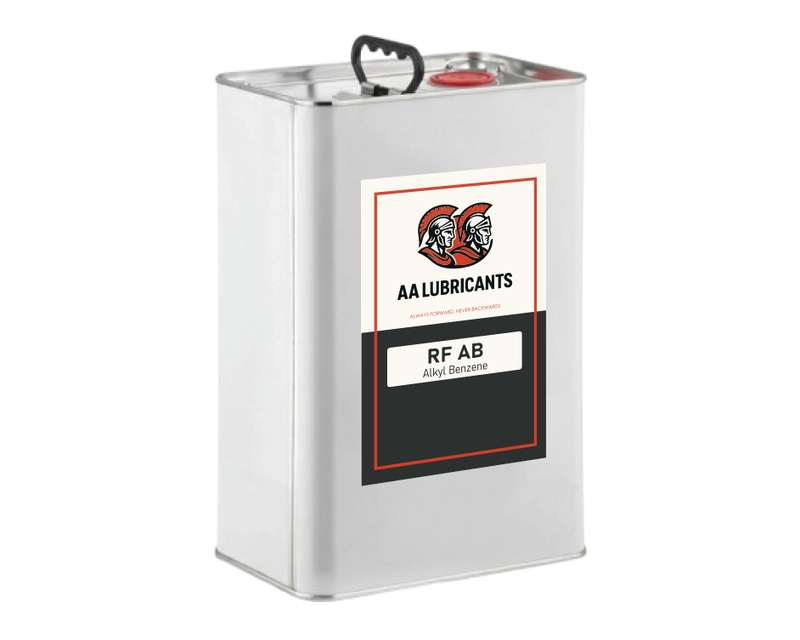
- Use the correct HCFC oil. RF MO (naphthenic mineral, grades 32 to 100) suits reciprocating and small compressors on R-22. RF AB alkylbenzene (grades 68, 100 and 150) offers better low-temperature miscibility, better oxidation stability and a lower floc point than mineral oil, and is widely preferred in R-22 screw compressors and low-temperature duty.
- Mineral and alkylbenzene oils are compatible with each other. Upgrading an R-22 system from mineral oil to alkylbenzene at an oil change is a practical way to improve oil return and stability in older plant.
- Keep the system tight and dry. Every leak now costs scarce refrigerant as well as reliability.
- Use oil analysis on large compressors to plan overhauls instead of reacting to failures.
Option 2: Retrofit to an alternative refrigerant
The retrofit refrigerant decides the lubricant. The key question is always the same: is the new refrigerant miscible with the oil that will be in the system?
| Retrofit route | Typical refrigerants | Lubricant implication |
|---|---|---|
| HFC blends designed for mineral oil compatibility | R-422D, R-438A and similar | Formulated to work with existing mineral or alkylbenzene oil in many systems, but oil return can be marginal in low-temperature evaporators and long pipe runs. Check the refrigerant maker's guidance. |
| HFC blends requiring POE | R-407C, R-404A, R-507 (duty-dependent) | Oil must be changed to POE and residual mineral oil reduced to a low level. |
| Lower-GWP HFO or HFO/HFC blends | Duty-dependent | POE is generally required; compressor OEM approval is essential. |
Retrofit refrigerants also change capacity, discharge temperature, glide and operating pressures. Expansion valves, pressure switches, and sometimes compressor selection must be reviewed. The oil change is necessary, but it is not the whole retrofit.
Changing from mineral oil to POE: the flushing procedure
POE tolerates a small amount of residual mineral oil, but too much remaining mineral oil will not dissolve in the HFC. It separates in the evaporator and causes the very oil-return problems the retrofit was meant to avoid. The industry target is usually to reduce residual mineral oil to below about 5% of the charge, and lower where the OEM or refrigerant maker requires it.
- Record the baseline. Log pressures, temperatures, superheat and oil level on R-22 before any change.
- Drain the mineral oil from the compressor, separator and any oil management system, and record the volume recovered.
- Charge with POE of the grade specified for the new refrigerant and compressor, for example RF POE 68 for many semi-hermetic reciprocating compressors or RF POE 170 / RF POE 220 for screw machines.
- Run on R-22 for a period to let the POE circulate and pick up residual mineral oil from the system.
- Drain and repeat. Two or three POE changes are commonly needed to reach the target. Measure residual mineral oil with a refractometer or laboratory test rather than guessing.
- Recover the R-22, replace filter-driers, evacuate deeply, and charge the new refrigerant.
- Re-commission and compare operation with the baseline. Check oil level closely during the first days of operation.
Throughout the process, handle POE as a hygroscopic oil: sealed containers, closed transfer, and a well-maintained vacuum pump. Our RF VP vacuum pump oils help keep the evacuation step effective.
Option 3: Replace
Where equipment is near the end of its life, replacement with a new system on a low-GWP refrigerant may be the better investment. New systems bring their own lubrication decisions, from POE grades for HFC and HFO machines to dedicated oils for CO2. Our other technical articles cover these in detail.
How AA Lubricants supports retrofit projects
We help contractors and plant owners choose between these options by looking at the whole system, not just the drum: compressor type and OEM approvals, refrigerant choice, operating envelope, pipework and the flushing plan. We then supply the right oils, from RF MO and RF AB for R-22 life extension to our RF POE range for the retrofit, together with the procedure to use them.
Planning an R-22 retrofit? Send your plant details to sales@aalubricants.co.za and our technical team will work through the lubrication plan with you.


