The price of miscibility
Polyolester (POE) oils are the workhorse lubricants for HFC and many HFO systems because their polar ester groups make them miscible with polar refrigerants. The same polarity makes them hygroscopic: they attract and hold water far more readily than mineral oil. A freshly packed POE is typically delivered at below 100 ppm water (our RF POE 68 data sheet quotes a typical 80 ppm; our RF MO mineral oils, by comparison, quote 30 ppm). Left open to humid air, a POE can take up several hundred ppm within hours.
Water in a refrigeration system is always unwelcome. In a POE system it is also a chemical reactant.
The hydrolysis chain
An ester is formed by reacting an acid with an alcohol. Hydrolysis is that reaction running in reverse:
Ester + Water → Carboxylic acid + Alcohol
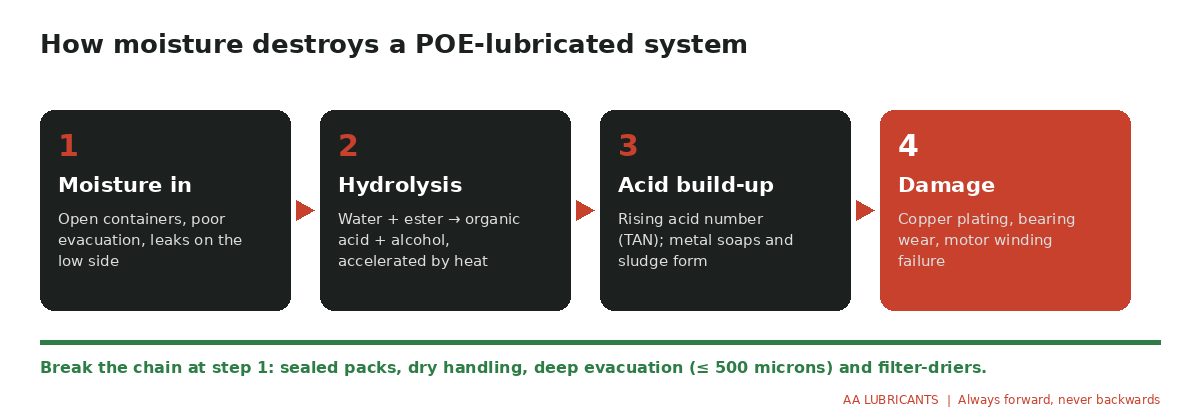
The reaction is slow at room temperature but accelerates with heat, and the discharge side of a compressor is hot. It is also self-reinforcing, because acids catalyse further hydrolysis. Once started, the damage progresses through four stages:
- Moisture enters through open containers, poor evacuation, low-side leaks, or wet components.
- Hydrolysis converts part of the oil into organic acids and alcohols.
- Acid build-up raises the oil's acid number (TAN) and forms metal soaps and sludge that block capillaries and expansion valves.
- Damage follows: copper plating on bearing and valve surfaces, accelerated wear, and in hermetic and semi-hermetic compressors, breakdown of motor winding insulation and burnout.
Free water also freezes at expansion devices in low-temperature systems, causing intermittent blockages that are often misdiagnosed as refrigerant shortage.
What to measure
| Parameter | Fresh RF POE (typical) | What it tells you |
|---|---|---|
| Water content (Karl Fischer, ppm) | 80 to 90 ppm | How dry the oil and system are. Many compressor OEMs set in-service limits in the region of 50 to 100 ppm for POE; follow the OEM figure. |
| Acid number / TAN (mg KOH/g) | 0.02 | Whether hydrolysis or oxidation has started. A rising trend matters more than any single reading. |
| Colour and odour | Clear, pale | Darkening with a sharp, acrid smell suggests acid formation or overheating. |
| Metals (spectrographic) | Near zero | Copper, iron and aluminium show where wear or corrosion is happening. |
A simple acid test kit in the field, backed by laboratory analysis on critical plant, catches most problems long before a compressor fails.
A practical dry-handling protocol
Storage
- Keep containers sealed until the moment of use. Our technical data sheets specify indoor storage below 60°C and, where outdoor storage is unavoidable, drums laid horizontally so rainwater and humid air cannot collect around the bung.
- Buy the pack size you will use in one service. A 4 L or 5 L tin used fully is better than a 20 L drum opened five times.
- Once opened, treat the remaining POE as suspect unless it has been resealed immediately and tested before reuse.
Charging
- Charge with a closed transfer pump, not by pouring through an open fitting.
- Never leave a compressor or system open to atmosphere longer than necessary. Cap every open line.
Evacuation
- Evacuate to a deep vacuum, commonly 500 microns (about 0.67 mbar) or better, measured with an electronic micron gauge at the system, not at the pump.
- Perform a decay test: isolate the pump and confirm the vacuum holds. A steady rise indicates a leak; a rise that levels off indicates moisture still boiling off.
- Keep the vacuum pump itself in good condition. Contaminated vacuum pump oil cannot reach a deep vacuum. Our RF VP Series vacuum pump oils are formulated for low vapour pressure and fast water separation, and should be changed after every heavily wet evacuation.
Protection in service
- Fit a correctly sized filter-drier, and replace it after any system opening or compressor change.
- After a burnout, use a suction-line acid-removal filter-drier and repeat acid tests until the oil is clean.
Why this matters commercially
Most POE-related compressor failures are not failures of the oil. They are failures of handling, evacuation or system dryness that the oil chemistry then amplifies. A supplier who simply sells POE by the drum leaves that risk with the customer. At AA Lubricants we supply the oil together with the handling and testing guidance that makes it perform, because a lubricant is only as good as the system it goes into.
For a moisture or acid problem on your plant, contact our technical team at sales@aalubricants.co.za with the refrigerant, oil type and any test results you have.


